Vaccines When You’re on Medication That Lowers Your Immune System
When I start someone on a medication that suppresses the immune system, one of the first questions I get is what they can do to protect themselves. Vaccines are a big part of that answer. Here’s how they work, which ones to ask about, and the few places where your medication changes the timing.
Most people have questions when they start a medication that lowers their immune system, and they should. The medication is doing something useful, it’s calming down an immune system that’s attacking you, but the same effect that protects your joints also makes it a little harder to fight off infections.
Vaccines are one of the better ways to protect yourself from the serious stuff. A common cold is an annoyance. Severe pneumonia, influenza, and COVID are a different category, and shingles can be brutally painful, with nerve pain that lingers for months or years afterward. Those are the ones you want to avoid.
The questions I get are usually about how much the medication raises infection risk, which vaccines to get, and whether the timing around the medication changes anything. So let’s go through those.
What a vaccine does
A vaccine shows your immune system a harmless piece of a virus or bacteria, or instructions for making that piece. Your immune system studies it, builds antibodies against it, and keeps a memory of what it looked like. If you encounter the real thing later, your body already knows what to do.
Here’s the way I explain it in clinic.
Think of your immune system as an army defending a base, and the base is your body. Without a vaccine, you’ve got a couple of guards at the entrance. Something gets past them without much trouble, and by the time the rest of the army mobilizes, the invader is already well inside and doing damage.
After a vaccine, you’ve got a trained front line waiting at the gate. Most of the time they stop the invader there. But if you’re exposed to enough of it, some can still get through. The difference is that now the whole army already knows this enemy and responds immediately, so what gets through gets cleared out fast instead of overwhelming you.
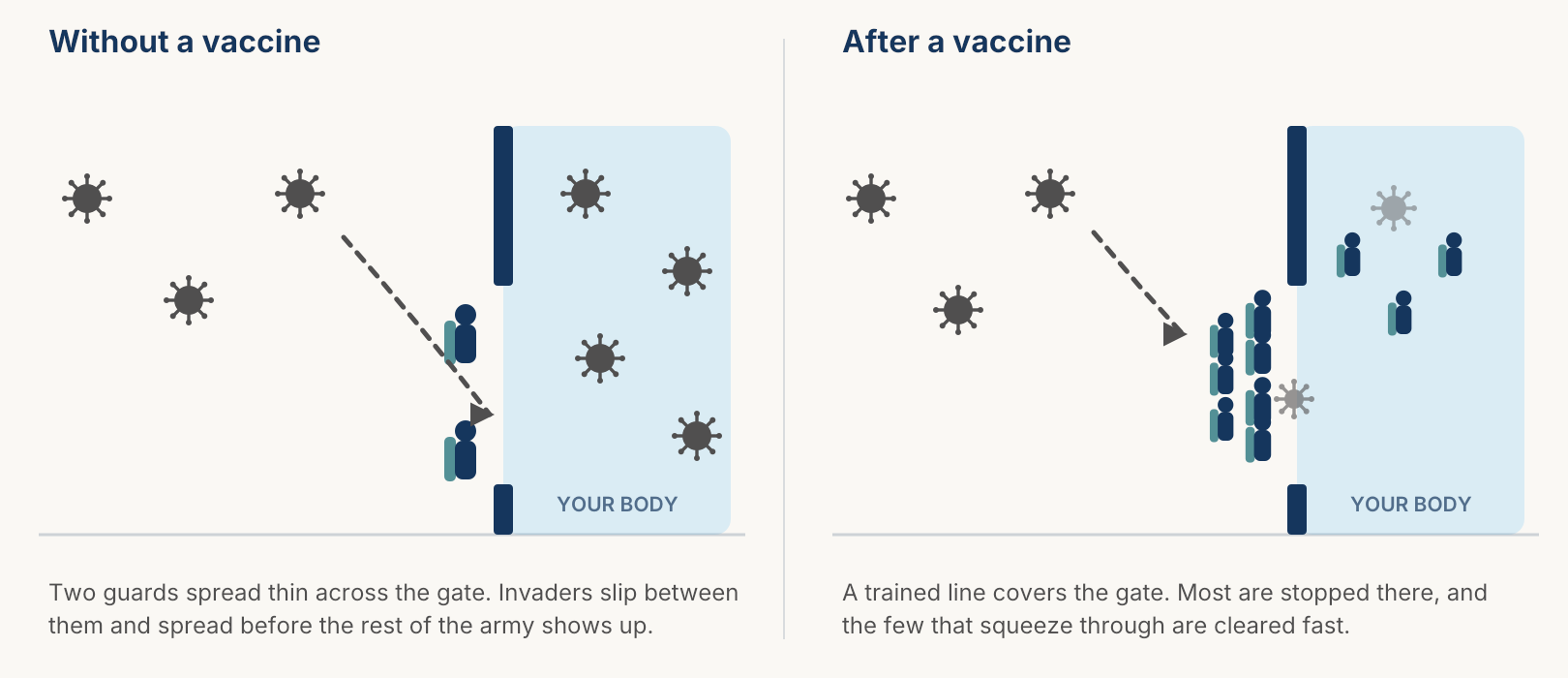
So no, vaccines don’t prevent every infection, and I’m not going to tell you they do. They lower your chance of getting infected, and when you do get infected, they make it less severe. For someone on immunosuppression, that second part is the whole point.
Why you might feel off for a day or two
I hear this from patients often, so here it is plainly: feeling tired, achy, or feverish for a day or two after a vaccine is not the vaccine giving you an infection.
What you’re feeling is the mobilization. Your immune system is recruiting and training that front line, and that process involves the same inflammatory signals that make you feel run down during an actual illness. It’s your body working, and it typically passes in 24 to 48 hours.
The general rule: most vaccines are fine on most medications
For most patients on most rheumatology medications, the answer is simple. Get the vaccine.
The line to know is live versus inactivated.
Inactivated vaccines don’t contain anything that can replicate. There’s no live organism to cause an infection, so they’re safe to give while you’re immunosuppressed. This covers almost everything you’d be offered: flu shots, COVID vaccines, pneumococcal, Shingrix, RSV, Tdap, hepatitis B.
Live vaccines contain a weakened but living organism. In someone with a normal immune system, it’s too weak to cause disease. In someone significantly immunosuppressed, it occasionally can, which is why we avoid them. The ones you might realistically run into:
MMR (measles, mumps, rubella)
Varicella (chickenpox)
Yellow fever
Oral typhoid
The nasal spray flu vaccine (the shot is inactivated and fine)
BCG
Ideally these get done before starting a biologic or other significant immunosuppression. In practice this rarely comes up, since most adults here had MMR and varicella as kids. Where it does matter is travel, yellow fever in particular, so bring up any upcoming trips. If you’re already on treatment and need a live vaccine, it’s a conversation, not an automatic no, but it takes planning.
Shingrix is not a live vaccine. It’s recombinant, meaning it uses a protein rather than a live virus. People mix it up with the older shingles vaccine, Zostavax, which was live and is no longer available in the US. Shingrix is safe on immunosuppression, and shingles risk is elevated in exactly this population, so it’s one of the more important ones to get.
The exceptions: where timing matters
A few medications need a little planning around vaccines. Find yours here.
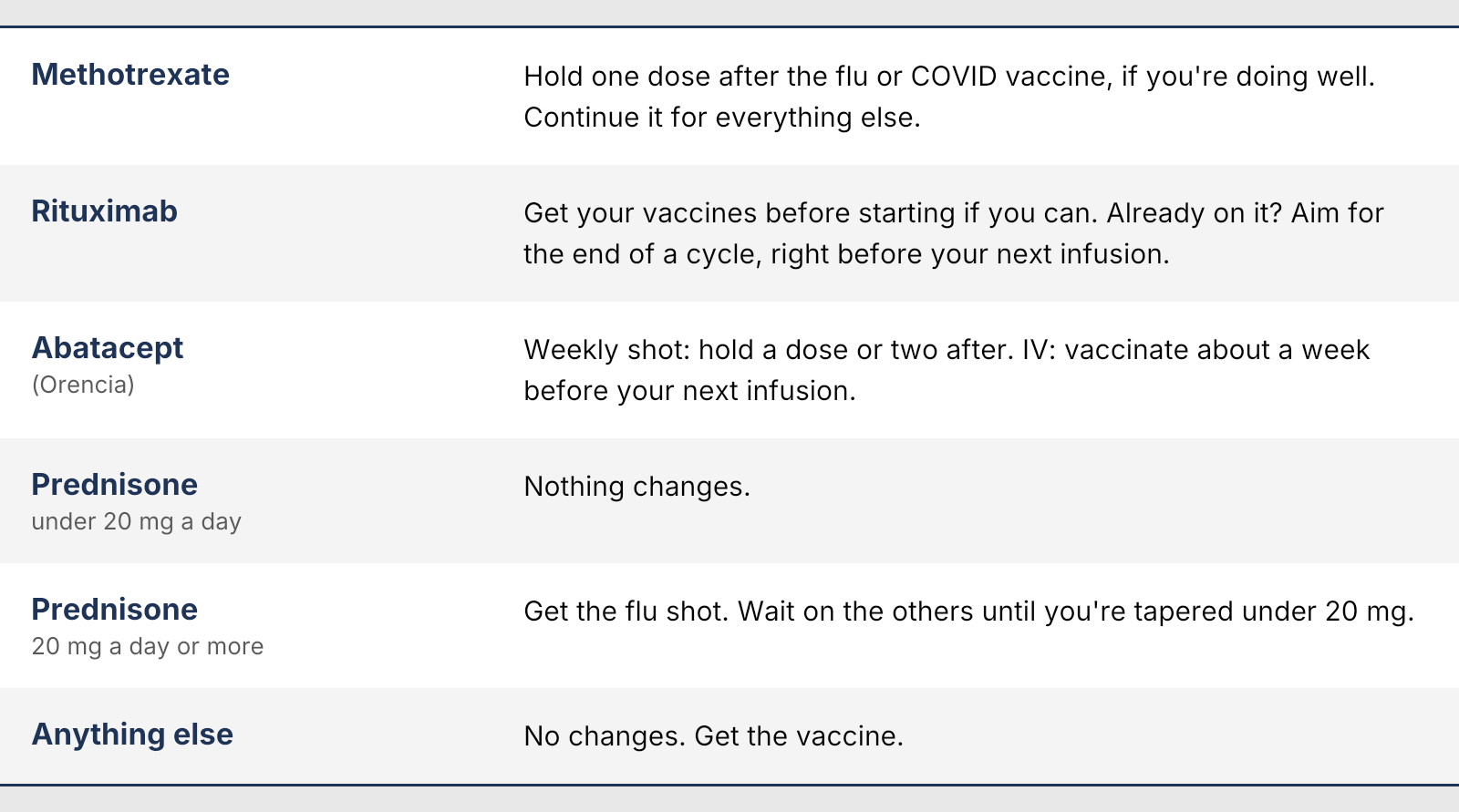
Four things the table can’t tell you.
If you’re flaring, we don’t hold. Period. Same if you flare every time you miss a dose. The hold is a nice-to-have. Keeping your disease quiet is not. A vaccine given without a hold beats a vaccine that doesn’t happen.
Rituximab is the one where timing really counts. It clears out the cells that make antibodies, so a vaccine given soon after an infusion doesn’t accomplish much. The rest of the list is fine-tuning. This one isn’t.
Steroid injections and creams don’t count toward any of this. Neither do inhalers, eye drops, or a short prednisone burst of a week or less. If I injected your shoulder last month, it has no bearing on your vaccines.
Ask before, not during. Nobody can sort out your infusion schedule at a pharmacy counter. One question at a visit handles it. Talk to your healthcare provider about whether holding a dose is appropriate for your situation.
Which vaccines to ask about
Seasonal ones. Influenza every year. COVID per current recommendations. If you’re 65 or older, ask for the high-dose flu vaccine rather than the standard one.
Shingles (Shingrix). Two doses. Shingles risk is higher on immunosuppression, and the lingering nerve pain afterward is the part you want to avoid.
Pneumococcal. Protects against one of the most common causes of bacterial pneumonia. Ask for Prevnar 20 by name. It’s one shot and you’re done. The older approach used two different pneumonia vaccines spaced a year or more apart, and it confused a lot of people, clinicians included. If someone starts explaining a two-vaccine sequence to you, ask whether Prevnar 20 is an option instead.
RSV. Not just a childhood illness. It puts a lot of older adults in the hospital every year.
Tdap and hepatitis B as appropriate, depending on your history.
A lot of patients don’t know this: several of these vaccines have an age cutoff for the general population, but being on a medication that lowers your immune system often qualifies you earlier. Shingrix and pneumococcal are both examples where immunosuppression moves you into the eligible group well before the standard age. If you’ve been told you’re too young, ask again and mention the medication you’re on. Then check with your plan to confirm coverage.
Bottom line
Starting immunosuppression is a good moment to take stock of where you stand on vaccines. Most of them you can get while on treatment, with no changes at all. Live vaccines are the exception and are best handled before you start. Methotrexate, rituximab, and abatacept are the ones where timing needs a little planning, and with prednisone it comes down to your dose.
If you’re not sure what you’ve had or what you need, bring it up at your next visit. It’s a short conversation, and it’s one of the easier ways to protect yourself while your treatment does its job.
This post is general education, not medical advice for your situation. Everything above depends on your diagnosis, how active your disease is, which medications you’re on, and at what doses. The holds in particular are judgment calls, and if you’re flaring, the answer is usually to skip the hold and get the vaccine. Talk it through with your rheumatologist or whoever manages your treatment before you change anything. If you’re a patient at Restore, just send me a message.
Sources
Bass AR, Chakravarty E, Akl EA, et al. "2022 American College of Rheumatology Guideline for Vaccinations in Patients With Rheumatic and Musculoskeletal Diseases." Arthritis & Rheumatology, 2023. The primary source for this post. Establishes the live versus inactivated framework, the two-week methotrexate hold after influenza vaccination, the rituximab end-of-cycle timing strategy, the prednisone dose thresholds, and the recommendation for high-dose or adjuvanted influenza vaccine in immunosuppressed adults under 65.
Centers for Disease Control and Prevention. "Altered Immunocompetence: General Best Practice Guidelines for Immunization." Defines the threshold for clinically significant immunosuppression as prednisone 20 mg per day or more for 14 days or longer, and confirms that topical, inhaled, and intra-articular or tendon sheath corticosteroid injections are not considered immunosuppressive.
Park JK, Choi Y, Lee SH, et al. "A Multicenter, Prospective, Randomized, Parallel-Group Trial on the Effects of Temporary Methotrexate Discontinuation for One Week Versus Two Weeks on Seasonal Influenza Vaccination in Patients With Rheumatoid Arthritis." Arthritis & Rheumatology, 2023. Found a one-week methotrexate hold comparable to a two-week hold for influenza vaccine response, 69 percent versus 75 percent at four weeks and essentially equivalent by sixteen weeks. Published after the 2022 ACR guideline, which still specifies two weeks.
Park JK, Lee MA, Lee EY, et al. "Effect of methotrexate discontinuation on efficacy of seasonal influenza vaccination in patients with rheumatoid arthritis: a randomised clinical trial." Annals of the Rheumatic Diseases, 2017. The earlier trial establishing that holding methotrexate for two weeks after influenza vaccination improves the proportion of patients achieving a satisfactory vaccine response. This is the evidence the ACR guideline recommendation was built on.
American College of Rheumatology. "COVID-19 Vaccine Clinical Guidance Summary for Patients with Rheumatic and Musculoskeletal Diseases," Version 5. Source for the abatacept timing guidance, including holding the subcutaneous form after vaccination and scheduling vaccination approximately one week before an intravenous infusion. Developed when immunogenicity was weighted more heavily than in the routine vaccination guideline.
Kobayashi M, Leidner AJ, Gierke R, et al. "Expanded Recommendations for Use of Pneumococcal Conjugate Vaccines Among Adults Aged 50 Years and Older: Recommendations of the Advisory Committee on Immunization Practices." MMWR, 2025. Confirms that a single dose of PCV20 or PCV21 completes pneumococcal vaccination for adults with immunocompromising conditions, with no PPSV23 dose required afterward.
Centers for Disease Control and Prevention. "Pneumococcal Disease." Epidemiology and Prevention of Vaccine-Preventable Diseases (Pink Book). States that pneumococci account for 10 to 30 percent of adult community-acquired pneumonia, with over 150,000 pneumococcal pneumonia hospitalizations estimated annually in the United States.
Immunize.org. "RSV Vaccine Recommendations for Adults." Summarizes the adult RSV vaccination schedule and the risk factors that qualify adults aged 50 to 74, including moderate or severe immune compromise from immunosuppressive medications. Estimates 60,000 to 160,000 RSV hospitalizations and 6,000 to 10,000 deaths annually among adults 65 and older.
Centers for Disease Control and Prevention. "What Everyone Should Know about Zostavax." Confirms that Zostavax, the older live shingles vaccine, has not been available in the United States since November 18, 2020, leaving Shingrix as the only shingles vaccine currently in use.