Lifestyle Medicine Isn't Fluff (And It's Not Instead of Your Medication Either)
This is the first post in a new series on lifestyle medicine, the six daily habits that shape how you feel and how your autoimmune disease behaves. Here's what it actually is, and where it fits alongside your treatment.
Let's start with the skepticism, because I hear it a lot. I hear it from patients sometimes. And honestly, I hear it from other providers too. "Lifestyle medicine" gets lumped in with supplements and wellness influencer culture. Something you talk about if you don't take real medicine seriously.
That's not what it is. Lifestyle medicine is just thinking about the whole person. It means recognizing that how you sleep, how you move, what you eat, how you handle stress, and who you spend time with all play a bigger role in your health than most people realize. Not just for autoimmune disease. For diabetes, fatty liver disease, high cholesterol, heart disease, and more. People feel better when they're living healthy.
What is lifestyle medicine?
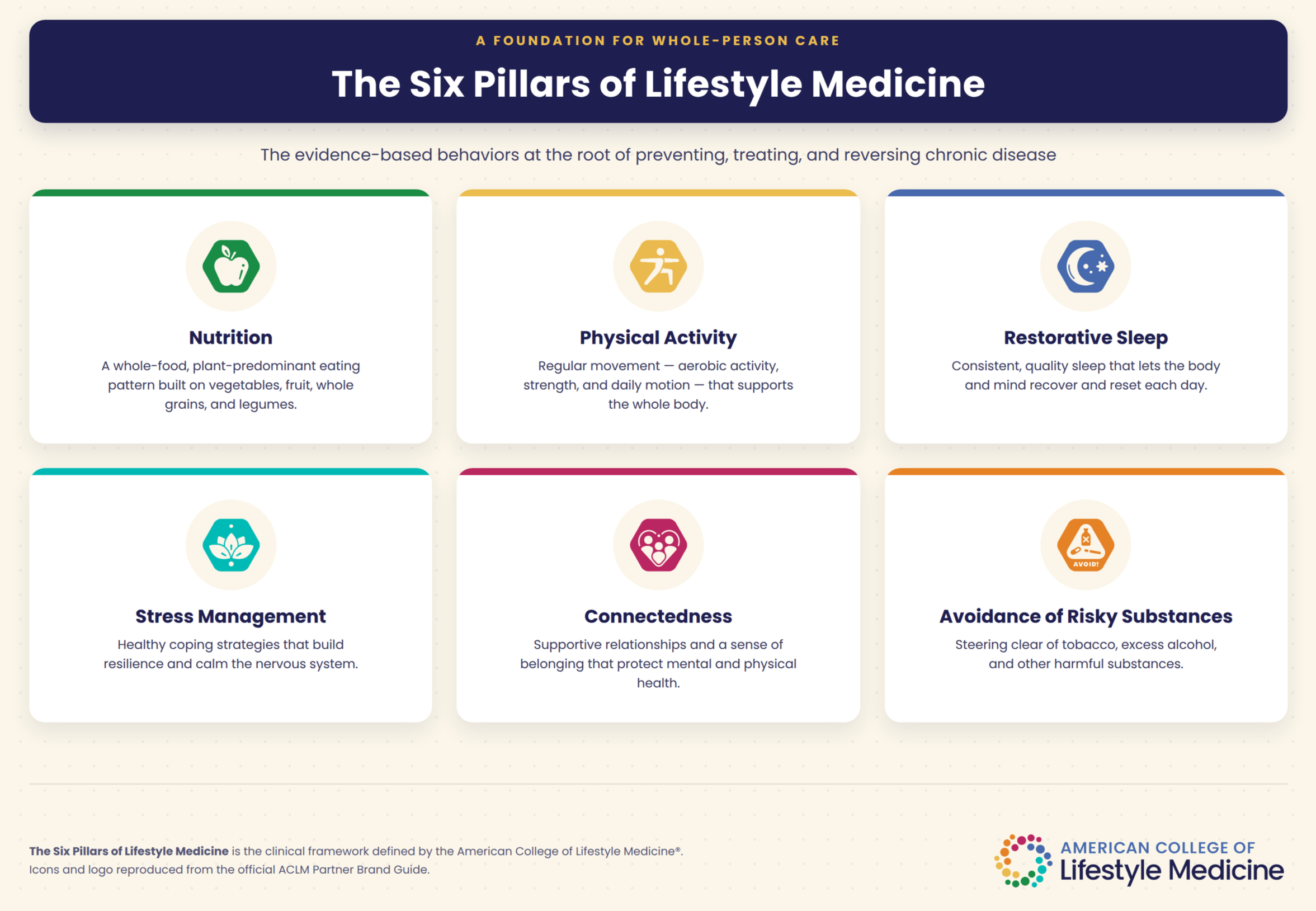
Lifestyle medicine is a board-certified medical specialty. I'm a Diplomate of the American Board of Lifestyle Medicine (DipABLM), which means I went through additional training and certification on top of my rheumatology background. It's built around six pillars: sleep, movement, nutrition, stress management, avoiding risky substances, and social connection.
Here's where I stand on this. My general approach to autoimmune disease is to treat aggressively early. With RA, for example, most of the permanent joint damage happens early in the disease course, so I strongly recommend starting medication early, unless someone has a very mild case or the diagnosis hasn't fully clarified itself yet. I start with DMARDs or biologics to get the disease under control, and at the same time I'm working with patients to find the lifestyle changes that could help.
For a lot of patients, that combination means they end up needing less medication over time, or they have more success tapering down once things are stable. I do have a handful of patients who manage well with lifestyle changes and little to no medication. But that's the exception, not the rule. For most people, lifestyle medicine is additive. It works alongside your treatment, not instead of it.
Why I lead with sleep
Most people assume nutrition or exercise is the natural starting point for a series like this. I'm starting with sleep instead.
Here's my reasoning. If you're not sleeping well, everything else gets harder. It's tough to motivate yourself to exercise when you're exhausted. Tough to eat well when you're running on fumes and reaching for whatever's fastest. Tough to manage stress when you're already depleted. Sleep isn't just one pillar among six, it's the thing that makes the other five more doable.
The six pillars, briefly
Sleep — the foundation. Poor sleep doesn't just make you tired, it drives inflammation.
Movement — joints that hurt still need to move, just the right way and the right amount.
Nutrition — food is medicine. There's no downside to eating well, and it's one of the most powerful tools you have.
Stress management — the stress-flare connection is real, and learning to manage it is part of managing your disease.
Avoiding risky substances — smoking in particular has real, well-documented effects on rheumatoid arthritis.
Social connection — probably the most overlooked one. Isolation is linked to worse pain, more disability, and higher mortality risk in people with arthritis.
I'll dig into each of these one at a time over the next several posts.
How this fits into rheumatology care
This is where lifestyle medicine and rheumatology overlap for me. Autoimmune disease isn't just about the joints or the labs, it's about the whole system, and your daily habits are part of that system. When I sit down with a patient, I'm not just adjusting medication. I'm asking about sleep, stress, movement, all of it. That takes time, which is part of why I built the practice the way I did. You can't have this conversation in a rushed fifteen-minute visit.
The bottom line
Talk to your rheumatologist about sleep, stress, and movement, not just your labs and your meds. They don't replace what's already working in your care, they build on it. The more lifestyle medicine becomes a normal part of how autoimmune disease gets treated, the better patients tend to do, both with their disease and everything else going on in their health.
Next up: sleep, and why it might be the most underrated tool you have for managing autoimmune disease.