Pain Beyond Inflammation: Fibromyalgia and Central Sensitization
Some pain continues after inflammation is controlled, and some pain was never inflammatory to begin with. Both are real, and both can be treated. Here's how I think about it in clinic.
Most of what I was taught about pain in medical school was about inflammation and damage. Find the source, treat the source. We weren't taught much about pain that comes from the nervous system itself, at least not when I trained. I hope that's changing.
I see this often in clinic, in two main ways.
Fibromyalgia is real
Some patients clearly have a widespread pain process, which we usually call fibromyalgia. It can show up on its own, or alongside an inflammatory disease like RA.
It’s not made up. It’s not something I diagnose when I can’t figure out what’s going on. It carries a stigma partly because there’s no test or scan to point to, so patients get doubted.
What it looks like:
Pain in many areas of the body, lasting months
Fatigue
Waking up unrefreshed
Brain fog (trouble with memory or focus)
There's no blood test or scan that diagnoses it. We diagnose it from the pattern of symptoms. Those symptoms can look a lot like autoimmune disease, which is a big reason these patients end up in my office. I'm often the one making the diagnosis, and part of that is making sure there isn't an autoimmune inflammatory condition behind the symptoms.
What I used to do. Once I'd ruled out autoimmune disease, I would send these patients back to primary care or to a pain clinic to work on the pain. I always felt bad about that. I know fibromyalgia well, and I typically have more time to work on it than a primary care visit allows. Pain clinics can help, but many are built around procedures and don't have much room in their schedules for someone with widespread pain.
What I do now. Since opening my direct care practice, I have as much time as a patient needs. That lets me work on improving their pain instead of only telling them what it isn't.
Pain that continues after inflammation is controlled
The other way I see this is in patients with RA or psoriatic arthritis. Their inflammation is controlled, but they still have pain. A few things can explain that:
Damage from before treatment. Joint damage that happened before the disease was controlled can stay painful.
Osteoarthritis. Cartilage breakdown is a normal part of aging. Some people feel it a lot, and others barely feel it at all.
Central sensitization. This is what I think about when there's no damage and no osteoarthritis to explain the pain.
I can often show this on ultrasound. I can look at the joint in the office and show the patient there's no extra fluid, no thickened joint capsule, and no increased blood flow. Those are the signs of active inflammation, and none of them are there. The pain still is.
Central sensitization is the best explanation. Your body keeps sending danger signals long after the danger is gone. I describe it as a pain dial that's turned up when it shouldn't be.
Think of a home alarm. When it's working normally, someone has to break down the door to set it off. With central sensitization, a knock on the door is enough. A knock isn't a danger signal, but to your nervous system it feels like one.
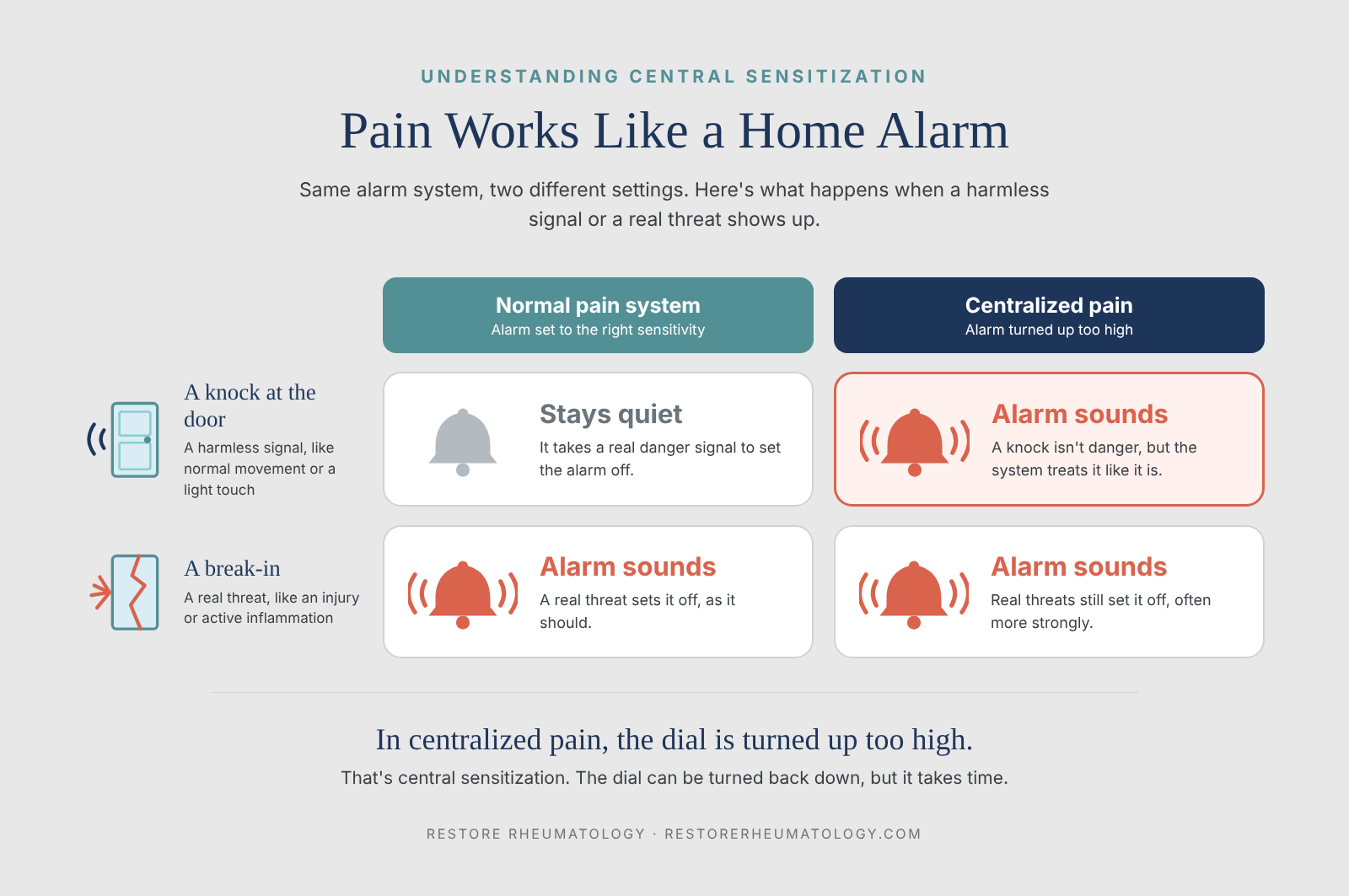
Why it happens. Your nervous system learns. After months or years of pain signals coming from an inflamed wrist, the circuits carrying those signals get stronger. When the inflammation is turned off, they don't shut off right away, so the pain can stay amplified. These circuits can change back, but it takes time to retrain your brain that you're safe.
More immunosuppression isn't the answer. If the inflammation is already off, stronger immune-suppressing medication won't fix pain that isn't coming from inflammation.
This is common. Studies vary, but roughly 1 in 5 people with RA or psoriatic arthritis also have fibromyalgia. It also shows up with lupus, Sjögren's, and other autoimmune conditions, though how often varies a lot between studies. In RA, it can make the disease look more active than it is, because the scoring partly relies on tender joints and how you say you feel. Telling the two apart helps avoid treating inflammation that isn't there and spares patients from unnecessary risk.
What I do about it
There's no single fix for this kind of pain. It takes a comprehensive approach, and the pieces below work together.
Education comes first. Understanding what's happening is incredibly important. Just knowing there isn't something dangerous or life threatening underneath your pain can help on its own. Education takes time, and it's a big part of why I like having longer visits.
Habit change is where the real change happens. I start by asking what might be turning the dial up. That means going through sleep, stress, nutrition, movement, social connection, and substance use, all covered in my lifestyle medicine series. Exercise is the only fibromyalgia treatment the European guidelines give a strong recommendation.
Therapy for pain sounds strange, but it helps. Cognitive behavioral therapy (CBT) for pain gets talked about a lot, and many people hear it and think, "Therapy for my pain? How is that supposed to help?" It isn't saying the pain is in your head. It teaches you how pain works and how stress, thoughts, and habits can feed it. In studies, CBT's clearest benefits are on how well people function and how much distress the pain causes, more than on pain scores themselves.
Medications can help, but they're not the final solution. Sometimes the best use is for sleep or stress. Pain makes sleep worse, bad sleep makes pain worse, and it snowballs. A medication can help break that cycle and get you back on track. I think of them as temporary, and the hope is to taper off them down the line. Many of them cause fatigue as a side effect, and fatigue is often already part of the picture in these patients, which limits how much we can use them.
If you want to go deeper, Tell Me Where It Hurts by Dr. Rachel Zoffness, a pain psychologist, is a great read. It shares real stories of patients who got better, and goes in depth on what goes into pain and how to manage it better.
Bottom line
Pain without inflammation is real, and it needs a comprehensive approach. Medication isn't always the answer. It can get better, and knowing that is step one.
Sources
Zoffness R. "Tell Me Where It Hurts: The New Science of Pain and How to Heal." Grand Central Publishing, 2026. A pain psychologist's explanation of how the brain shapes pain and how pain can change.
Duffield SJ, Miller N, Zhao S, Goodson NJ. "Concomitant fibromyalgia complicating chronic inflammatory arthritis: a systematic review and meta-analysis." Rheumatology, 2018;57(8):1453-1460. doi:10.1093/rheumatology/key112. Found fibromyalgia in about 21% of patients with RA and 18% with psoriatic arthritis (with high variation between studies), and higher disease activity scores in RA patients with fibromyalgia.
Torrente-Segarra V, et al. "Fibromyalgia prevalence and related factors in a large registry of patients with systemic lupus erythematosus." Clinical and Experimental Rheumatology, 2016;34(2 Suppl 96):40-47. Found fibromyalgia in 6.2% of 3,591 lupus patients, with other studies reporting higher and lower figures.
Choi BY, et al. "Prevalence of fibromyalgia is increased in primary Sjögren's syndrome compared with SLE and associated with depression and severe vitamin D deficiency." ACR/ARHP Annual Meeting abstract, 2012. Found fibromyalgia in 28% of patients with primary Sjögren's syndrome.
Wolfe F, et al. "2016 Revisions to the 2010/2011 fibromyalgia diagnostic criteria." Seminars in Arthritis and Rheumatism, 2016;46:319-329. Defines fibromyalgia by the pattern of widespread pain, fatigue, unrefreshing sleep, and cognitive symptoms, not by a test.
Williams ACdeC, et al. "Psychological therapies for the management of chronic pain (excluding headache) in adults." Cochrane Database of Systematic Reviews, 2020. doi:10.1002/14651858.CD007407.pub4. Across 59 CBT studies, found small improvements in disability and distress and a negligible effect on pain itself.
Macfarlane GJ, et al. "EULAR revised recommendations for the management of fibromyalgia." Annals of the Rheumatic Diseases, 2017;76(2):318-328. doi:10.1136/annrheumdis-2016-209724. Exercise was the only treatment with a strong recommendation, with education and non-drug therapy as the first step.